

Foxfiny com is a WordPress-based multi-topic blog publishing general articles on finance, education, health, travel, and technology. No named authors, editorial team, or owner are disclosed on the site. It is not known to be fraudulent, but the absence of credentials and citations makes it unreliable for financial, medical, or legal decisions. Use it for casual reading only and verify any important claims elsewhere.
What Foxfiny Com Actually Publishes Across Its Seven Categories
Foxfiny com organises its content into seven navigation categories: Finance, Education, Health, Travel, Technology, Automotive, and Business. Each section contains short-to-medium blog posts written in plain language, structured as listicles or how-to guides. The Finance section includes articles on credit score basics, credit card selection, and trading platforms such as MetaTrader 4 (MT4). The Health section covers natural remedies and general wellness tips. Travel posts take the form of destination guides and safety-focused listicles, with content covering countries including Turkey and Russia.
The breadth of topics is intentional. Multi-topic blogs like foxfiny com aim to capture organic search traffic across a wide range of queries rather than building authority in any one niche. A student searching for study strategies, a first-time investor reading about credit scores, and a traveller planning a trip could all land on the same domain but on completely unrelated articles. This approach generates traffic but does not signal expertise. The common mistake readers make is treating a wide-ranging site as a comprehensive resource. The correct approach is to treat each article as a starting point, not a final answer, because no single blog can maintain deep expertise across seven distinct fields.
Why the Absence of Named Authors Is a Significant Problem
None of foxfiny com’s published articles carry a named author, and the site does not publish an editorial policy, credentials page, or “About” section identifying the team behind the content. This is unusual even by the standards of general-interest blogs, where most credible publishers including NerdWallet, Investopedia, and MoneySavingExpert display author bios, qualifications, and review processes for financial and health content.
For a reader consulting the Finance section about credit card selection or debt repayment strategies, this matters practically. A licensed financial advisor and a content writer with no financial training can produce articles that look identical on-screen. Without disclosed authorship, there is no way to verify which one wrote what you are reading. The same applies to the Health section: anonymous wellness advice cannot be traced back to any medical professional or institution. ScamAdviser and similar trust-rating tools flag anonymous site ownership as a risk factor not because it guarantees fraud, but because it removes the accountability structure that allows readers to judge reliability. Foxfiny com’s content may be accurate in places; the problem is that there is no systematic way to know which parts are and which are not.
You May Also Read: businessgrowthhacker.com Phoenix Business Growth Consultant: What It Actually Does and Whether It’s Worth It
How HTTPS Encryption Affects Safety and What It Does Not Cover
Foxfiny com uses HTTPS encryption, which is confirmed across multiple review sources. HTTPS means that data transmitted between a visitor’s browser and the server is encrypted no third party can intercept what you are reading or what you type into the site. This is a baseline security feature in 2026, and its presence does not indicate that a website is trustworthy, credible, or legitimate in any broader sense.
The common mistake is equating HTTPS with site quality. The correct understanding is that HTTPS protects the connection not the content. A blog that publishes inaccurate financial advice or unverified health claims can run on HTTPS. A phishing site can run on HTTPS. According to Google’s own transparency reporting, virtually all web traffic is now encrypted regardless of site type. For foxfiny com specifically, HTTPS means your browsing activity is not exposed in transit. It does not mean the finance articles have been reviewed by a qualified professional, and it does not mean the site’s ownership is transparent. Readers should treat the padlock icon as a floor, not a ceiling, when evaluating any website.
Why Review Sites Describe Foxfiny Com So Differently
A notable pattern appears when searching “foxfiny com review”: different sites describe it as a content blog, a financial tool, an e-commerce platform, and in some cases a scam store. This inconsistency is itself informative. Several review articles appear to be low-quality AI-generated content written without visiting the actual site, pulling contradictory descriptions from other summaries rather than direct observation.
One source describes foxfiny com as offering “online store creation,” another as a “budgeting tool with expense tracking,” and a third correctly identifies it as a WordPress blog with no transactional features. The most credible characterisation supported by the site’s own navigation structure is a content blog with no confirmed tool, no product catalogue, and no verified financial service. When review articles about the same URL contradict each other this sharply, it usually means most of those reviews were not produced by writers who visited the site. Readers searching for information about foxfiny com should prioritise assessments that describe specific pages, article categories, and observed site behaviour over reviews that speak only in generalities about “ease of use” or “clean design.”
How Foxfiny Com Compares to Credible Financial Literacy Sources
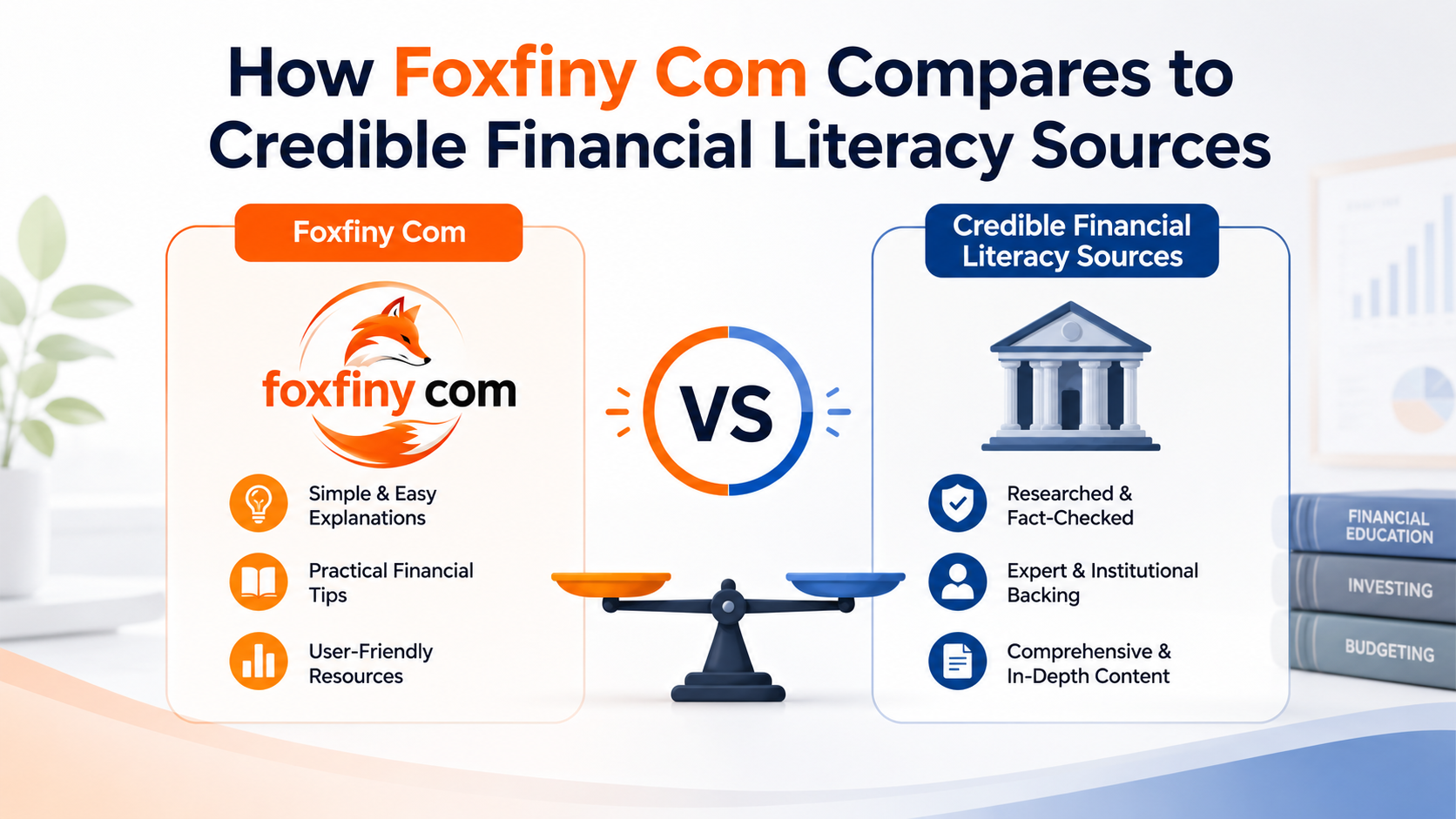
Foxfiny com’s Finance section sits at the entry-level end of personal finance content. Articles explain credit scores, card selection, and basic investing concepts in plain language which has value for readers with no prior financial knowledge. However, the gap between this content and established financial literacy platforms is wide.
NerdWallet and Investopedia both publish author bios, editorial standards documents, and disclose when content has been reviewed by a licensed financial advisor. MoneySavingExpert, founded by Martin Lewis, operates under a strict editorial independence policy and discloses commercial relationships with financial products. These platforms cite specific regulations, interest rates, and financial products by name with current data. Foxfiny com’s Finance content does not cite sources, does not disclose whether articles reflect current regulations, and does not indicate when articles were last reviewed for accuracy. For a reader deciding between credit cards or planning debt repayment, this distinction is not minor. Outdated or unverified financial guidance can lead to real financial harm missed deadlines, misunderstood APR terms, or incorrect assumptions about credit scoring systems vary by country and change over time.
What the Multi-Niche Blog Model Means for Content Depth
Foxfiny com follows a publishing model common to ad-supported general interest blogs: publish a large volume of accessible articles across many topics to maximise organic search reach. This model has structural consequences for content quality that readers should understand.
A specialist blog covering only personal finance like The Simple Dollar or Money Under 30 can develop editorial guidelines, build writer expertise, and update articles when regulations change. A multi-topic blog covering finance, health, travel, automotive, gaming, and education simultaneously cannot allocate the same editorial depth to any one subject. The result is content that is easy to read but shallow in analysis. A 700-word foxfiny com article on “how to improve your credit score” will not address country-specific credit bureau rules, the difference between VantageScore and FICO, or how recent inquiries interact with utilisation rate. These omissions are not errors they reflect the format’s limits. Readers who understand this can use foxfiny com appropriately: as a first orientation to an unfamiliar topic, not as a guide for making a significant financial decision.
The Real Risk: Applying General Blog Advice to Specific Financial Decisions
The most concrete risk foxfiny com presents is not fraud it is miscalibration. A reader who treats general blog advice as applicable to their specific financial situation can make measurable errors.
Personal finance is highly jurisdiction-specific. Credit scoring works differently in Pakistan, the UK, and the United States. Tax rules for freelancers differ by country. Debt repayment strategies depend on local insolvency law. Foxfiny com does not appear to geo-target content or disclose which jurisdiction its Finance articles address. A reader in Karachi and a reader in London reading the same foxfiny com article on credit cards will encounter identical text, despite operating in entirely different regulatory environments. ICANN and international privacy regulations such as GDPR also mean that the site’s data practices may not align with the reader’s local rights. For health content, the same problem applies: a natural remedy article written without reference to local drug interaction guidelines or regional healthcare advice is not neutral it is incomplete in ways that could cause harm if acted on without professional verification.
What the Information Gain Section Reveals: The “Review Laundering” Pattern Around Foxfiny Com
This section covers something absent from all existing foxfiny com articles in search results.
A clear pattern in the foxfiny com search landscape is what can be called review laundering a cycle where low-quality AI-generated review articles about the site reproduce and amplify inaccurate descriptions of it, each citing the previous round. One article describes foxfiny com as an “e-commerce platform with online store creation.” A second article cites the first. A third cites the second. None of these articles appear to involve a writer who visited foxfiny.com and navigated its actual pages.
This matters for anyone trying to find accurate information about the site. When a search for “foxfiny com review” returns ten results, perhaps two contain first-hand observation. The rest are content farms reproducing the same synthetic summary in new words. This phenomenon common around newly registered or low-traffic domains is not unique to foxfiny com. It reflects a broader structural problem with how general-interest blogs are covered online: the review ecosystem around them is as unreliable as the sites themselves.
A reader who wants to assess foxfiny com honestly should do three things that no existing review article recommends explicitly. First, navigate the actual site and read three to five articles in the Finance or Health section, checking whether sources are cited and whether dates are visible. Second, search for the specific claim from any foxfiny com article independently on a credible source if the claim holds up, the article was accurate on that point; if it does not, that article should not be trusted going forward. Third, check the site’s About page and Privacy Policy if either is absent or vague, that is a direct signal that the publisher does not intend to be accountable to readers. These three steps take under ten minutes and will give any reader a more accurate picture of foxfiny com’s actual reliability than any secondary review article.
You May Also Read: AI Contextual Governance Business Evolution Adaptation: The Practical Guide for 2026
Conclusion
Foxfiny com is a general-interest WordPress blog not a financial tool, not an online store, and not a specialist platform of any kind. The three most important things to carry away from this review: first, the site covers seven topic categories in shallow, plain-language articles that lack named authors and cited sources; second, HTTPS encryption confirms basic connection security but says nothing about the accuracy or reliability of the content itself; third, the finance and health sections carry real risk if used as a basis for consequential decisions rather than as a first-pass introduction to unfamiliar topics. The single most useful action you can take today is to open a foxfiny com article alongside an Investopedia or NHS equivalent on the same topic and compare the depth of sourcing directly that comparison will immediately clarify how to calibrate the site. As search algorithms continue rewarding editorial accountability, anonymous multi-niche blogs like this will either add author credentials and disclosure policies or lose visibility to sources that do.
Frequently Asked Questions
Is foxfiny com a scam?
Foxfiny com is not conclusively linked to fraud or phishing. It functions as a content blog, not an online store, so the “scam” characterisation found on some review sites appears to misidentify the site type. The genuine concern is credibility, not fraud: no author names, no cited sources, and no owner disclosure make it unreliable for serious decisions.
Who owns foxfiny com?
No owner, editorial team, or named author is publicly disclosed on foxfiny com. The site uses WordPress infrastructure and HTTPS, but WHOIS privacy protection means registrant details are not publicly visible. Ownership opacity is one of the main reasons independent reviewers caution readers against using it as an authoritative source.
Is foxfiny com safe to browse?
For casual article reading, foxfiny com appears safe in the technical sense it uses HTTPS encryption and has not been flagged as malware by major security tools. Avoid entering personal or financial details into any forms on the site unless clear privacy disclosures are provided. Do not use the site as a source for medical, financial, or legal decisions.
What topics does foxfiny com cover?
Foxfiny com publishes articles across seven categories: Finance, Education, Health, Travel, Technology, Automotive, and Business. Finance posts cover credit scores and basic investing. Health covers wellness and natural remedies. Travel covers destination guides and safety listicles. Content is written in plain language for non-specialist readers.
Does foxfiny com require a login or account?
Based on available descriptions of the site, foxfiny com does not require account registration to read articles. It operates as a standard public-access content blog. If any section of the site requests personal information or login credentials, verify the privacy policy before proceeding.
How does foxfiny com make money?
Like most general-interest blogs, foxfiny com likely earns revenue through display advertising, which is standard for WordPress-based content sites. No affiliate disclosure or sponsored content policy has been publicly identified, which is itself a transparency concern under guidelines from regulators such as the FTC.
Can I trust foxfiny com’s finance advice?
No. Foxfiny com’s Finance articles are written by unnamed authors without disclosed qualifications. The content does not cite sources, does not specify which country’s regulations apply, and may not be updated after publication. For credit, investment, or debt decisions, use regulated sources such as NerdWallet, Investopedia, or government financial guidance websites.
Why do different websites say completely different things about foxfiny com?
Many review articles about foxfiny com are AI-generated content that describes the site inaccurately, often portraying it as an e-commerce platform or financial tool rather than a blog. This inconsistency is a byproduct of the review-farm publishing model. The most accurate descriptions come from sources that observe the site’s actual navigation structure and content directly.


