

mylawyer360.com is a free online attorney-matching platform based in the United States. Users fill out a short intake form describing their legal issue, and the site matches them with licensed attorneys in their area within 24 to 48 hours. The platform also publishes free legal guides on topics like divorce, criminal defense, and personal injury. It does not give legal advice and does not directly represent clients. Attorney vetting transparency is limited.
What Is mylawyer360.com?
mylawyer360.com is an online legal resource and attorney-matching service designed for people in the United States who need legal help but don’t know where to start. The platform has two main functions: it publishes free educational guides on common legal topics, and it tries to connect users with licensed attorneys near them based on the nature of their case.
The site covers a wide range of practice areas. These include family law (divorce, child custody, adoption), personal injury, criminal defense, employment disputes, immigration, and business law. Users can read articles, browse FAQs, and learn about different types of lawyers without paying anything or creating an account.
The attorney-matching side works through a form-based intake process. A user describes their issue, provides their location, and submits the form. The platform’s system then identifies attorneys from its network who practice in the relevant area and contacts them on the user’s behalf. Matches typically arrive within 24 to 48 hours, and many of the listed attorneys offer free initial consultations.
The site was built on WordPress and has been active since at least 2024. It openly disclaims that it does not practice law and that any information on the platform is for general informational purposes only not a substitute for advice from a licensed attorney. This disclaimer is important and appears prominently across the site.
Is mylawyer360.com Actually Free, or Are There Hidden Costs for Users?
The platform is free for users this is not a catch. You do not pay to submit your intake form, browse the legal guides, or receive attorney matches. The cost structure works the other way: attorneys who join the network pay referral fees to the platform after a client retains them. This is a standard model used by services like LegalMatch and some tiers of Avvo.
Most people assume “free legal help” means a watered-down experience. That is not quite right here. The free access covers the full matching process, not just a teaser. Many attorneys in the network also offer free initial consultations, which means a user can speak with a licensed lawyer about their situation at no upfront cost.
Where costs do appear is once you hire an attorney. Hourly legal fees in the US typically run between $150 and $500 per hour, depending on the state and practice area. Personal injury lawyers commonly work on contingency they take 30 to 40 percent of any settlement, and you pay nothing if the case is lost. Employment lawyers may also work on contingency for certain claim types.
The one thing that is not publicly disclosed is exactly what attorneys pay to participate in the platform, or whether attorney sponsorship status affects the order in which matches are presented. If you receive multiple attorney matches, it is worth asking each one how they found your case and whether any paid placement was involved.
How the mylawyer360.com Matching Process Works From Intake to Consultation
The matching process on mylawyer360.com follows four stages. First, you fill out the intake form a short questionnaire asking about your legal issue, what outcome you are hoping for, and your location. You do not need an account to do this.
Second, the platform’s algorithm processes your case details and cross-references them against its attorney network by practice area and geography. The system is designed to match by specialty an immigration question does not get sent to a divorce attorney. This filtering is a meaningful feature that basic legal directories like FindLaw do not offer.
Third, matched attorneys receive your case summary and can choose to respond. The platform sends you their profiles, along with availability for a consultation. You can book an initial meeting directly through the portal. Some users report receiving matches within a few hours, though the official window is 24 to 48 hours.
Fourth, after your initial consultation, the platform prompts you to rate the experience. These ratings feed back into the matching system to maintain quality over time.
One limitation that most reviews skip over: the platform does not guarantee exclusivity. The attorney may be responding to multiple referrals from different platforms at the same time. When you speak with a matched attorney, confirm they are not already at capacity on similar cases before you share sensitive details.
What Legal Areas Does mylawyer360.com Cover and Where It Has Gaps
mylawyer360.com covers most of the legal categories that individuals and small businesses commonly face. Family law is the most prominent the site provides detailed content on divorce proceedings, child custody arrangements, spousal support calculations, and adoption. Criminal defense is another strong area, with guides addressing arrests, DUI charges, drug offenses, and what to expect at arraignment.
Personal injury content is thorough and includes workplace injuries, slip-and-fall accidents (including a specific article on Michigan winter conditions), and accident claims. Business law, employment disputes, and immigration round out the core practice areas.
Where the platform is thinner: highly specialized areas like intellectual property litigation, securities law, tax controversy, and federal regulatory compliance are not well covered in the guides. The attorney network may include practitioners in these areas, but the educational content is limited by comparison.
Most people think an attorney-matching platform gives equal coverage across all legal fields. That is not accurate here the platform concentrates most of its content on the five or six practice areas where everyday consumers are most likely to seek help. If your legal issue falls outside those areas (say, a complex patent dispute or an international arbitration matter), mylawyer360.com is a starting point at best. You would need a specialist directory or a direct referral from a law school clinic.
How mylawyer360.com Compares to Avvo, LegalMatch, and LegalZoom
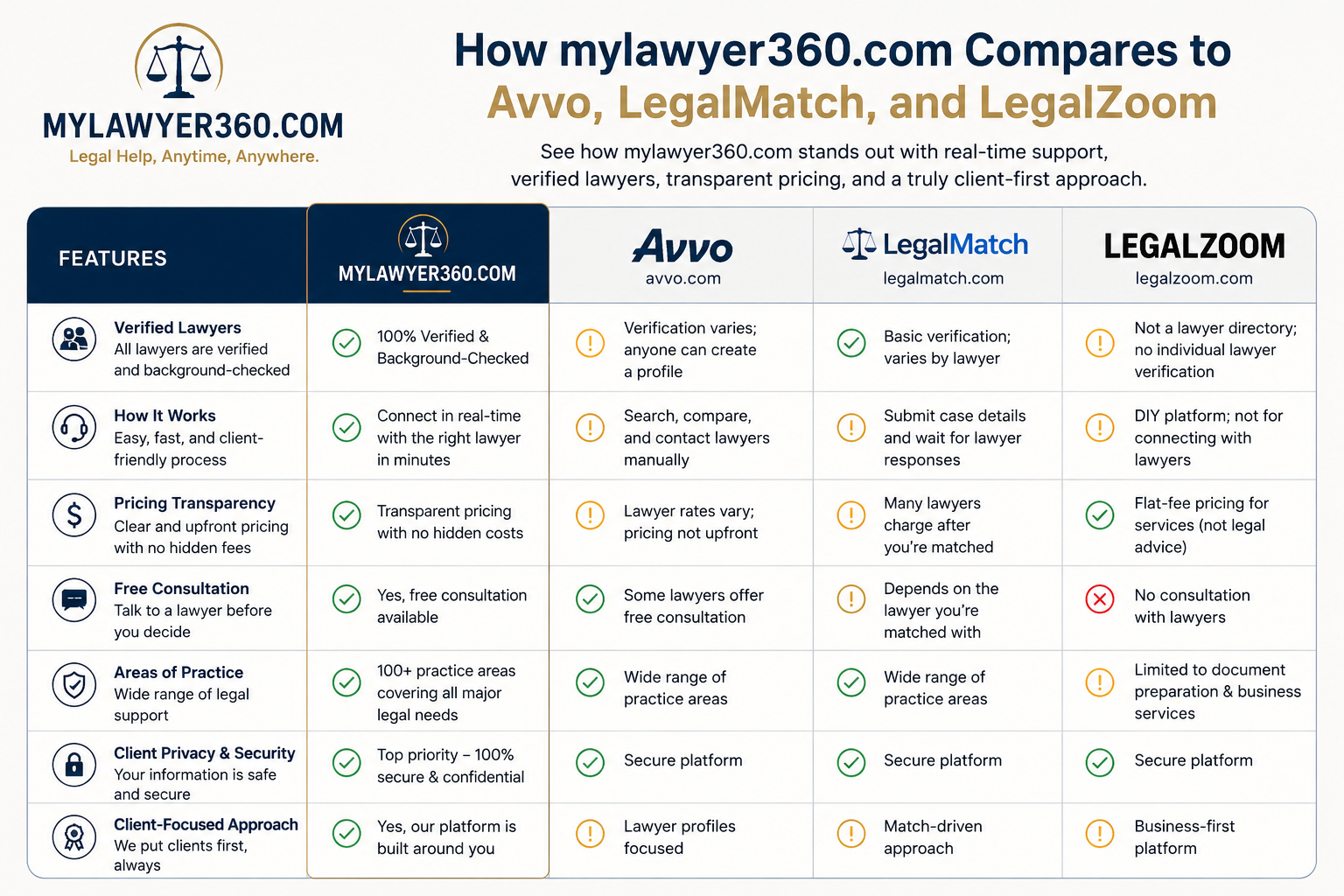
The legal platform market has several well-established players, and mylawyer360.com is newer than all of them. Understanding the differences helps you pick the right starting point.
Avvo has been operating since 2007 and holds the largest consumer-facing legal directory in the US the American Bar Association’s 2023 Legal Technology Survey found that 67 percent of respondents used Avvo during their attorney search. Avvo also features lawyer Q&A sections, peer endorsements, and a disciplinary history display. mylawyer360.com does not show disciplinary history on attorney profiles, which is a gap.
LegalMatch works similarly to mylawyer360.com in its matching model users post their issue and attorneys respond but LegalMatch has a longer track record and a larger attorney network. LegalZoom focuses on document preparation and DIY legal forms; it is better suited to someone forming an LLC or drafting a will than someone facing a criminal charge.
mylawyer360.com’s advantage is simplicity. The intake form is short, the interface is clean, and the process requires no account creation to get started. For someone who has never dealt with the legal system and just needs to be pointed in the right direction, it removes friction that other platforms add through registration walls and upsells.
You May Also Read: MyLawyer360.com Explained: What You Need to Know Before Hiring Any Attorney
What mylawyer360.com Says About Attorney Vetting and What It Doesn’t
This is where the most important gap in the platform’s transparency lives. mylawyer360.com states that attorneys in its network are verified bar licenses are checked, and qualifications are reviewed. That baseline check confirms the attorney is licensed to practice in your state and is not suspended or disbarred. That is a meaningful minimum.
What is not publicly explained is how thorough the process goes beyond bar license confirmation. The platform does not publicly disclose whether it checks for malpractice history, pending disciplinary proceedings, or client complaint records. A bar license check tells you an attorney is legally permitted to practice it does not tell you whether they are good at their job or whether they have been the subject of formal complaints.
By contrast, Avvo displays a disciplinary section on every attorney profile, pulling records directly from state bar databases. This is something mylawyer360.com does not appear to replicate.
The practical takeaway: before retaining any attorney you find through mylawyer360.com, run their name through your state bar’s public disciplinary database independently. In the US, every state bar association maintains a free, searchable online database of licensed attorneys and their standing. This step takes about three minutes and gives you information the platform itself does not surface.
What mylawyer360.com’s Legal Guides Actually Give You Without Hiring Anyone
A part of the platform that gets undervalued in most reviews is its free educational content. The guides on mylawyer360.com are written in plain language and cover the procedural steps in common legal situations what happens when you are charged with a crime, how to document a workplace injury, what a divorce timeline looks like, and how to evaluate whether you need a specialist versus a general practitioner.
For a user who has never interacted with the US legal system, this content has real practical value. Someone who reads the criminal defense intake guide before speaking with a matched attorney arrives at that consultation with a clearer picture of what questions to ask. That changes the quality of the conversation.
The guides also help users identify whether they need a lawyer at all. Not every legal situation requires paid representation. A landlord-tenant dispute in a small claims court setting, for instance, is something many people navigate without an attorney. mylawyer360.com’s content helps draw that line.
One thing the guides do not do: they do not constitute legal advice, and the site is explicit about this. Every guide includes a disclaimer. A person in a complex or time-sensitive legal situation a custody emergency, an imminent criminal trial, a deportation proceeding should not treat the guides as a substitute for representation.
What mylawyer360.com Does Not Tell You About How Legal Referral Platforms Profit From Urgency
This section covers something that does not appear in any of the top search results for mylawyer360.com, and it matters to anyone using the platform under stress.
Attorney-matching platforms make money when users retain attorneys not when users walk away after a free consultation. This creates a structural incentive that most platforms never disclose directly: the faster and more emotionally urgent a user’s situation feels, the more likely they are to retain the first attorney who responds, without comparison-shopping.
This is not unique to mylawyer360.com. It applies to LegalMatch, Avvo’s premium service, and most referral models. But the design of intake forms asking questions about urgency, describing deadlines, listing potential consequences amplifies the feeling that you need to act immediately. For users dealing with criminal charges or custody emergencies, that feeling is sometimes warranted. For others, it leads to retaining an attorney before properly evaluating their options.
The specific thing you can do to counteract this: after receiving your attorney matches from mylawyer360.com, schedule consultations with at least two of them before deciding. Most legal situations including many that feel urgent have a window of days or weeks before a decision absolutely must be made. Use that window. Ask each attorney the same set of questions. Compare how clearly they explain your options, not just how quickly they respond. The American Bar Association recommends consulting at least two attorneys before retaining one for any matter involving significant financial or personal stakes. mylawyer360.com’s own intake flow does not remind users of this.
You May Also Read: GoMyFinance.com Saving Money: What Works, What Doesn’t, and What to Do First
Frequently Asked Questions
Is mylawyer360.com a real law firm or just a referral site?
mylawyer360.com is a referral and information platform, not a law firm. It does not employ attorneys and cannot represent clients in legal matters. The platform connects users with licensed attorneys in their area. Any legal advice comes from the attorney you choose to hire, not from the platform itself.
How long does it actually take to receive attorney matches from mylawyer360.com?
The platform states matches arrive within 24 to 48 hours. Many users report receiving responses within a few hours, particularly for common practice areas like personal injury or criminal defense in metro areas. Matches may take longer for specialized practice areas or rural locations with fewer attorneys in the network.
Do I have to pay anything to use mylawyer360.com as a client?
No the platform is free for users. You pay nothing to submit your intake form, receive attorney matches, or access the educational guides. Attorneys pay referral fees to the platform after a client retains them. Any legal fees come from your agreement with the attorney you hire.
Are the lawyers on mylawyer360.com licensed in my state?
The platform states it checks bar licenses as part of its verification process. Attorneys should only appear in matches for states where they hold an active license. As a further check, run any attorney’s name through your state bar association’s free online directory before sharing sensitive case details or signing a retainer agreement.
Can I use mylawyer360.com if I have a criminal case?
Yes. Criminal defense is one of the platform’s primary categories. Users dealing with arrests, DUI charges, drug offenses, theft, or assault can submit their case details and receive matches with criminal defense attorneys. Many of these attorneys offer free initial consultations before any commitment is required.
Does mylawyer360.com protect the personal information I submit?
The platform states it uses encryption for communications and limits data sharing to matched attorneys. Specific technical measures such as GDPR compliance or detailed encryption standards are not publicly documented on the site. If you have strong privacy concerns before submitting sensitive details, contact the platform directly to ask about their data handling protocols.
How is mylawyer360.com different from just searching Google for a lawyer?
A Google search returns a list of attorneys with no filtering by practice area, case type, or availability. mylawyer360.com runs your case details through a matching filter before presenting attorney options. This increases the chance your first consultation is with someone who handles your type of case, rather than a generalist who refers you elsewhere.
What should I do if the attorney match I receive through mylawyer360.com doesn’t seem right?
Contact the platform to request a new match or adjustment. You are not obligated to work with the first attorney presented. Use the consultation to assess fit before signing anything. If none of the matches suit your situation, check your state bar’s referral service most state bars operate free or low-cost attorney referral programs with verified specialist panels.
Conclusion
mylawyer360.com is a legitimate free attorney-matching platform that serves as a useful starting point for US residents who need legal help but don’t know where to begin. You now know three specific things: the platform connects users with attorneys within 24 to 48 hours at no cost to the user; its educational guides are genuinely useful for first-time legal situations; and its attorney vetting process, while including bar license checks, does not publicly disclose how far beyond that baseline it goes. The single most important action you can take right now is to independently verify any matched attorney through your state bar association’s free public disciplinary database before retaining them. Online legal platforms are maturing rapidly transparency around vetting and data handling will likely become a competitive differentiator as the market consolidates around Avvo, LegalMatch, and newer entrants like mylawyer360.com fighting for the same users.


